
How Old Do You Have to Be to Be on Facebook? A Deep Dive into Slovaks on Social Media
Introduction
The stereotype goes that Facebook has become a social network for “older” people, while their children have moved on to Instagram and TikTok. But is that really true?
We analyzed social media data to find out how different demographic groups are represented on social networks. For the analysis, we used data from advertising platforms, so the figures show how many people in Slovakia can be reached with ads. Because perfectly accurate data straight from the social networks isn’t available, we work with the midpoint of each estimated range. We processed data from Facebook, Instagram, TikTok, Snapchat, LinkedIn, and Pinterest this way.
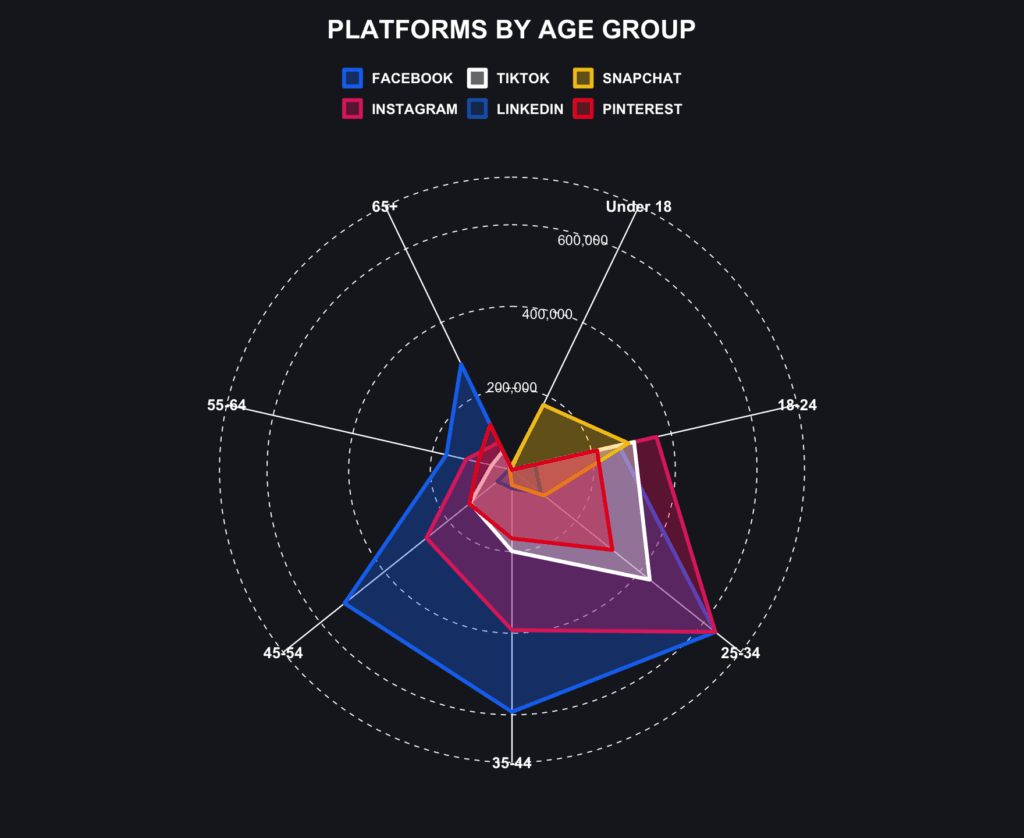
The data immediately reveals several trends across generations. The age structure of Instagram and TikTok users skews toward younger audiences, while Facebook is also widely used among middle-aged groups. We can also flip this visualization.
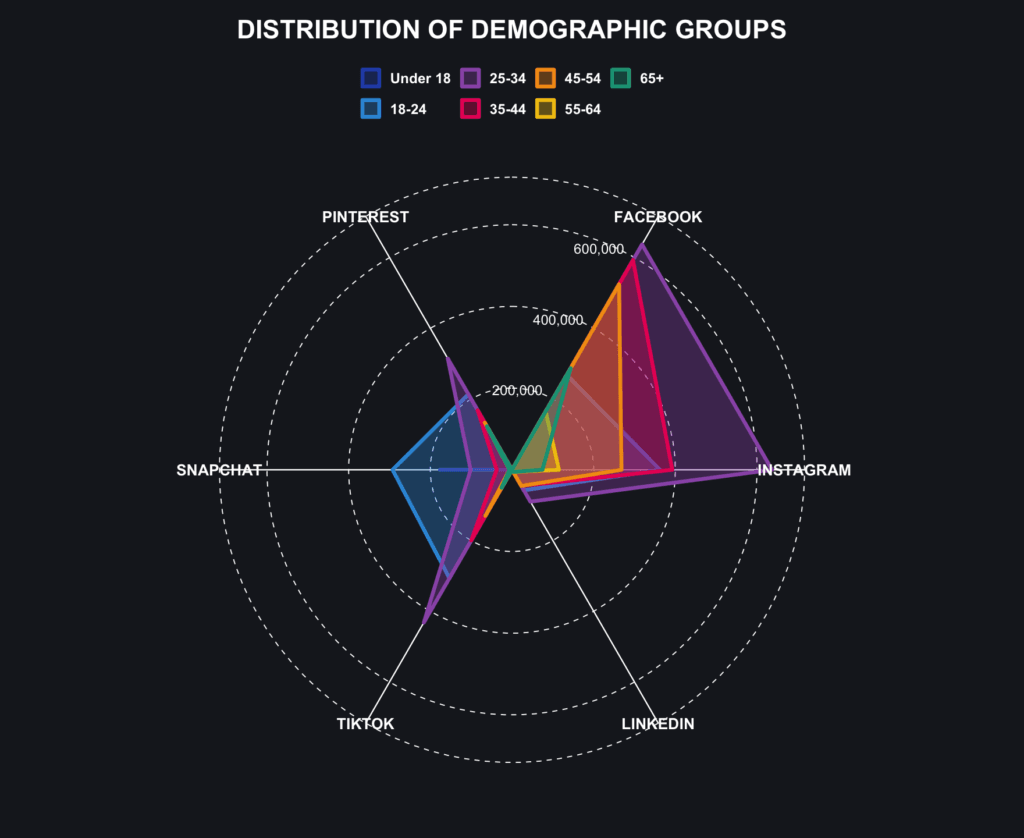
Here, we see that the youngest age group is interested in all platforms except LinkedIn, which is only natural. To some extent, it’s also to be expected that older age groups clearly gravitate toward Facebook and show less interest in other platforms.
The radial charts at the beginning of the article are a great tool for spotting trends, but for a truly in-depth analysis, we need to look at the data behind them. Next, we’ll look at the demographic breakdown. But let’s start with the total number of users on each platform.
Facebook remains the largest social network, with more than 2.4 million users. The second most used platform is Instagram, with more than 1.7 million users. No other social network has passed the one-million mark, although TikTok, in third place, is not far off.
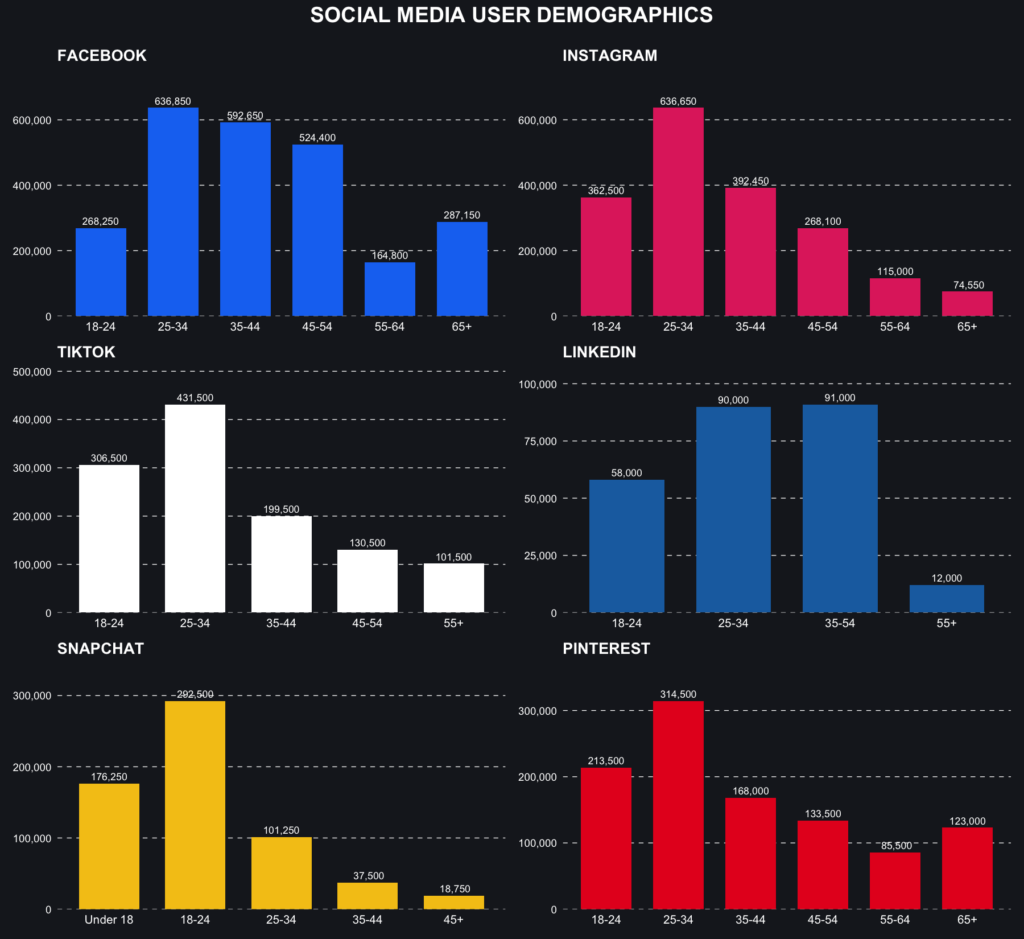
For the three most popular platforms – Facebook, Instagram, and TikTok – the strongest group is users aged 24–35. The key difference, however, is that while Facebook and Instagram each have almost 640,000 users in their strongest category, TikTok has only just over 430,000 in its core demographic. It’s also interesting that while the number of Facebook users gradually declines across age groups, on Instagram and TikTok the core age group is far ahead of the next one.
The stereotype that people of retirement age have settled only on Facebook seems to have some truth to it. While this age group numbers almost 290,000 users on Facebook, Instagram has just under 75,000. Surprisingly, though, this group is also well represented on TikTok and Pinterest.
The other platforms also deserve our attention, even though their user bases are many times smaller. Unsurprisingly, the strongest age group on LinkedIn is people of working age who are looking to give their careers a boost through the platform. Equally unsurprising is Snapchat, whose popularity among users over 24 is negligible. Snapchat also stands out as the only platform that lets advertisers target audiences under 18. The last platform we examined, Pinterest, is also strongest in the two youngest age groups. For users over 35, Pinterest holds less appeal, which may be related not only to their relationship with social media but also to the fact that these users are less open to seeking out new creative ideas and focus more on their established hobbies.
We can further break down user numbers by men and women to see whether there are significant differences along these lines. It should be noted that gender data isn’t always available. This means that when examining the gender makeup of individual platforms, the figures may not fully match the overall results.
This breakdown shows major imbalances on LinkedIn and Pinterest. While LinkedIn is clearly dominated by men, Pinterest has emerged as a network with a predominantly female user base. This more granular view also shows that there are no major differences across age groups. The aggregated overview below confirms these conclusions, while also showing that Instagram and TikTok have a slight female majority.

Conclusion
There are plenty of stereotypes about how different generations use social media. That’s why we at New School collected and analyzed data on the user makeup of individual platforms. We believe this data will help you replace vague assumptions with clear facts and bring a new level of authenticity to your communication. After all, online, it’s not just about who you’re reaching, but above all about how well you understand their real needs.
Do you want to receive our data and analyses and be part of the community?
