How We Build Good Neighborly Relations
for Development Projects in Prague
Introduction
New construction in cities today almost always becomes a hot topic, since it affects the lives of local residents. It often runs into outright irrational resistance and rejection of any project, even a good one. Yet the vast majority of new developments bring fresh life, public spaces, and community amenities to a neighborhood.
Communicating with new neighbors is therefore becoming increasingly important for developers, and it often determines whether and when a project even gets built at all.
A good example is one of Prague’s largest developers, who approached New School Communications to help involve residents near their projects in the planning process and convince them that the company wanted to be a good neighbor.
3 Principles for Building Good Neighborly Relations
There’s no magic formula that will convince everyone of a project’s benefits, but in every communication we stick to these principles:
1. Open, human communication from the earliest stages of project planning. In practice, this means a specific, named person – ideally the project manager – always communicates directly with neighbors.
2. Looking at the project from the neighbors’ point of view. How will the project affect their lives, what local problems does it solve, and what benefits will they gain from it – a new playground, say, or a renovated local kindergarten?
3. Listening to neighbors’ feedback and involving them in shaping the project, in an effort to find a compromise everyone can accept.
Of course, it’s almost never the case that everyone ends up satisfied, but easing neighbors’ resistance to the project – and above all winning over neutral or previously uninvolved residents – is an important outcome in itself. The so-called silent majority is therefore usually the main target group.
How Does the Whole Participation Process Work?
1. We Start with a Detailed Analysis of the Area and Its Residents
Since our work is data-driven, getting to know the area and its residents thoroughly right from the start is absolutely essential.
Communication channel analysis – in this phase, we determine which media and channels matter most in the area. What residents read, which Facebook pages or groups they’re part of, and where they go to voice complaints when something bothers them.
Analysis of formal and informal “influencers” – here we identify people who have influence over the target groups, i.e. every official and unofficial influencer in that specific area. This ranges from mayors, housing association representatives, and petition committees to Facebook group admins and the loudest activists on social media.
Monitoring – the final step is a thorough review of petitions, media, and social media, so that we’re up to speed from the outset and can respond before an issue grows into a potential crisis.
2. Presenting the Plan to Residents – a “Meeting over the Map”
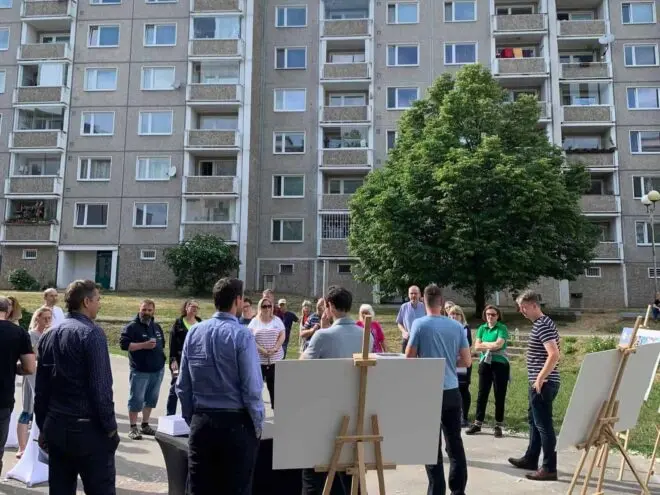
This is the first in-person meeting between the developer’s project managers and the neighbors, housing association representatives, and in some cases the mayor or local council members too. This first meeting is dedicated to presenting the concept and the zoning study, before the project is developed into its final form. Its purpose is to gather feedback from neighbors – what would be useful to people in the area, what they’re unhappy with, and so on.
3. Presenting the Project
At the second meeting, the specific project is presented – the number of floors, its architectural design, and how public spaces will be handled. These meetings are informal by design. It’s always a picnic, a barbecue, a coffee-and-cake afternoon, or a beer-and-hot-dog get-together, and we make sure there’s a program for kids too. While parents and grandparents chat with the developer’s representatives, the children play on a bouncy castle, get their faces painted, and so on.
4. Regular Project Updates
The subsequent, long-term phase of participation involves maintaining relationships with neighbors through:
a participation website for presenting the project and sharing updates on community activities,
social media – accounts on FB and IG, plus closed groups for internal communication among neighbors
informal events (a pre-Christmas cabbage soup gathering, a concert for Children’s Day, and so on), and a personal letter in residents’ mailboxes with updates on the project’s progress.
Building the Brand of a Responsible Developer
Alongside all the activities and meetings mentioned above, we also launch an online campaign geographically targeted at residents of the project’s area and people who spend time there. This is often complemented by outdoor advertising in the neighborhood and PR communication in the form of articles and other media coverage in local outlets.
Building a positive perception of the developer matters not just for the project itself, but also for future developments in other areas or cities. Neighbors’ satisfaction, or disappointment, tends to carry over to the developer’s next projects, and how the developer was perceived before is often a key factor in how well it’s received in a new location.
Being a good neighbor pays off.